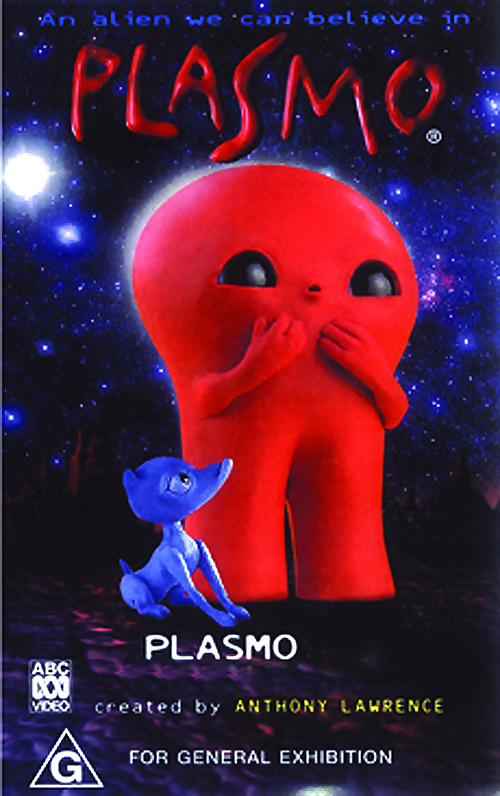
A pink clay alien stumps his lonely way across a desert. He has legs the way a T-rex has arms and a penguin has wings: not very successfully. He’s trying to get into space by piling up garbage in a large heap.
Plasmo is both naive and wise. Like the Sufi mystic in an Arabian folk tale, he is a clever fool. The cup that is both empty and full. He lacks life experience but is brimming with insight. A normal person cannot reach space by climbing a teetering pile of trash, but perhaps Plasmo can.
The character is the work of Australian animator Anthony Lawrence, who brought this special alien to the airwaves twice. In 1988, as a 26-minutes short film called Happy Hatchday to Plasmo. Then in 1997, as a 5-minute thirteen-episode TV series called Plasmo. This second adaptation played frequently on ABC, and was syndicated and dubbed for foreign markets.
The show was not a massive hit—if Taylor Swift plays Olympic Park Stadium on the same night Plasmo reruns are on TV, she surely wins the battle for Australian hearts and minds. I sense millions of PlasmoHeads protesting in the comments “b…but…what if her tickets are really expensive? What if her current boyfriend is really racist? What if it’s cold and rainy and…” no, friends, we must face the facts: Taylor Swift is more popular than Plasmo. Be brave and accept the truth in its monstrous cruelty, as Plasmo would.
But it did alright, considering. A decent percentage of Gen X Australia has grown up with a pink clay monster in the back of their head along with “how’s the serenity?” and old AFL footie jingles, and that’s not nothing. Plasmo’s species is (I think) a “polybop”, and many teens identify as poly now. So the character was a trendsetter in that respect.
Both Plasmo versions are an interesting yardstick to judge the other one by.
The 1988 film is grimy, wonderful space trash. Stylistically it’s Gumby meets Star Wars, with intergalactic bounty hunters, oceans of sand and ice, and grungy urban sewers. The two comic relief characters—Coredor and Brucho—are both great, even if their designs aren’t fully there yet. They’re voiced by musician-and-actor Phillip Houghton with a voice like mucus-coated gravel. Lucas’s “used future” aesthetic proves a real workhorse on sets created out of scraps and rags (the used present, one might say), because it creates a reality amenable to technical errors. In the 4k upscales on Lawrence’s Youtube, you can clearly see that the ice on Pynco is styrofoam, for example. But this strangely makes it seem even cooler than when I first watched it in standard definition, because I can better appreciate the labor that went into creating it. [1]I wrote that this scene was likely a reference to the moon-skating in Wallace and Gromit’s Big Day Out…but then I checked, and Happy Hatchday to Plasmo was on the air one year earlier! Someone … Continue reading
The 1997 Plasmo is a lot better on a technical level. The effects are more elaborate, and the designs more intentional. In 1988 Coredor was a fleshtone Gumby with an eyepatch. In 1997 he’s a talking pair of labia lips atop a swaying monitor lizard neck. He looks wonderful! The polybops are cuter too, with big expressive eyes kept weepy and moist via liberal brushings of peanut oil.
Yet it loses some of the dirt and grit that makes the original a blast (gone, too, is the subversive, edge-of-acceptable humor, like birds defecating in mid-air and Brucho wanting to go to the disco to meet “intellectually stimulating chicks”. I like that sort of thing more than ABC’s Standards and Practices did, I guess). It’s like a steam-cleaned version of the Plasmo concept.
But the 1997 show has a stronger plot. Gotta give it that. Plasmo finds a spaceship, uses it to get off the planet, crash-lands on another planet—Monjotroldeclipdoc, which has a hole punched through its middle by a long-ago comet). The show then settles into an “issue of the week” formula for seven or eight episodes: Plasmo tries to fix his ship while helping various people with problems like a blocked drain and a ghost-haunted library. Then the great comet unexpectedly returns to Monjotroldeclipdoc’s skies, doomsday looms, and Plasmo and his friends must make a choice.
Plasmo is a thoughtful show, not afraid to confront young viewers with tough ideas.
There’s the variant of Prisoner’s Dilemma found in “Nice to be Nice” (if Coredor knocks over Plasmo’s glass of milk, should he retaliate?). And the invocation of cosmic fractality (and the Avataṃsaka Sūtra) in “Plasmo in Deep Space” (which has a sharp and horrifying screenplay). There’s allusions to Ringworld and Citizen Kane (As a child, I would have missed the latter even if I’d been aware of Citizen Kane—the ROSEBUD on the sled is hard to see in 720×480).
Even the fact that “Monjotroldeclipdoc” is pronounced with an alveolar click on the final c (notated something like Monjotroldeclipdɒǃ, I think)…how often do you hear African click consonants on a kids’ show? When I was small I didn’t get all that, of course, but the show felt noticeably…deep compared to the programs before and after. There’s a lot of “they didn’t have to make the effort but I’m glad they did.”
Production-wise, Plasmo was an audacious mixture of basically every animation technique available at the time. It had claymation, stop-motion puppets, some cel animation (for effects like lightning bolts) and CGI, most of it integrated quite well. (The CGI has aged the worst, obviously.)
Lawrence’s team achieved remarkable stuff on a small budget. He once maintained a website where he discussed some of the effects—like using a pair of mirrors to create the haunting interior of the ship where Plasmo was hatched.
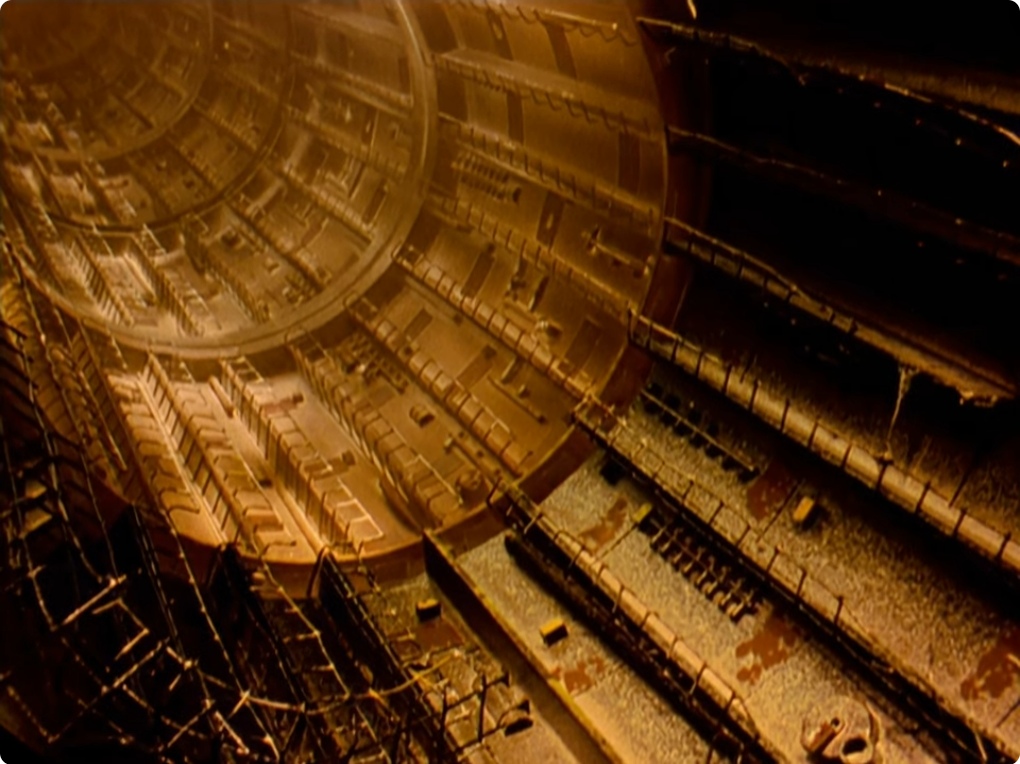
Is it strange that this is why I respond to Plasmo with sadness as much as nostalgia? 1997 was near the end of the line for this kind of Will Vinton/Ray Harryhausen stop-motion whateveryoucallit. If it had been made even three years later, likely every part of it would have been computer-animated.
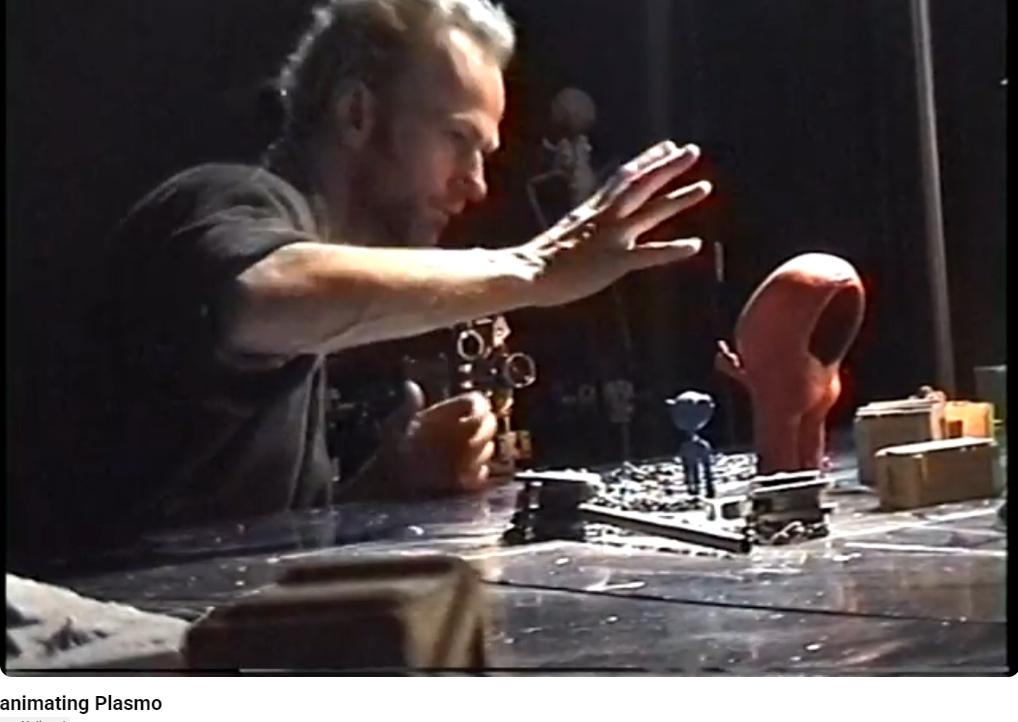
For better or for worse? Animating all this stuff by hand sounds like misery. Lawrence says the 1988 film took two years to animate and hospitalized him at one point.
But I think restrictions—the denial of shortcuts—can affect art in interesting ways that are not always negative. The crucible of labor can force choices that are ultimately correct ones—pruning away excess, tightening up dead spots in the script, working out conceptually what the point of the show or character even is. It is possible to film and write nothing. It is not possible to animate nothing. This is what attracts me to animation as a viewer: the medium fights bloat and excess by its nature.
And it’s a shame when old techniques are no longer used. The end result is that they cannot be used, even if you want to use them.
When animator Don Bluth worked for Disney in the 1970s, he was struck by the fact that much about the studio’s 30s/40s hot streak had already been forgotten. It wasn’t just the spirit of those old movies that was missing, even basic techniques were falling through the sands of time.
The Nine Old Men were going gray. Walt himself had been dead for half a decade. Nobody was preserving the hard-won knowledge and craft of the studio’s RKO years. He would ask questions like “how did you do the rippling water in Snow White and the Seven Dwarves?” and be astonished that nobody could tell him. In some cases, even the technique’s inventors had forgotten!
Ever since the failure of Sleeping Beauty, Disney had been fighting a war against budget overruns. Animators were urged to cut costs, to reuse footage, to do more with less. The result was that old knowledge and techniques atrophied because there wasn’t the money to apply them. What doesn’t get used gets forgotten: and soon you’re doing less with less. Bluth had arrived in a dying place: its animators the caretakers of an ancient language they could no longer read. Almost like Plasmo himself, trying to reach the sky with old scraps of the past.
What would it take to create Plasmo today? Or in another thirty years? Would it even be possible? Could puppetmakers of Nick Hilligoss’s skill be found? Would tools like surface gauges and plasticine still be readily available? I don’t know how many of the techniques required are even still taught at film school. How long before this character is simply impossible to bring back, except as a horrible CGI/AI shell of itself? It might be like that often-mocked meme about building a cathedral in the modern age. “We can’t. We don’t know how to do it.”
To address more important topics, Plasmo’s model looks like this from behind. Which is really disturbing.
References
| ↑1 | I wrote that this scene was likely a reference to the moon-skating in Wallace and Gromit’s Big Day Out…but then I checked, and Happy Hatchday to Plasmo was on the air one year earlier! Someone owes Lawrence a cheque! |
|---|
No Comments »
Comments are moderated and may take up to 24 hours to appear.
No comments yet.